
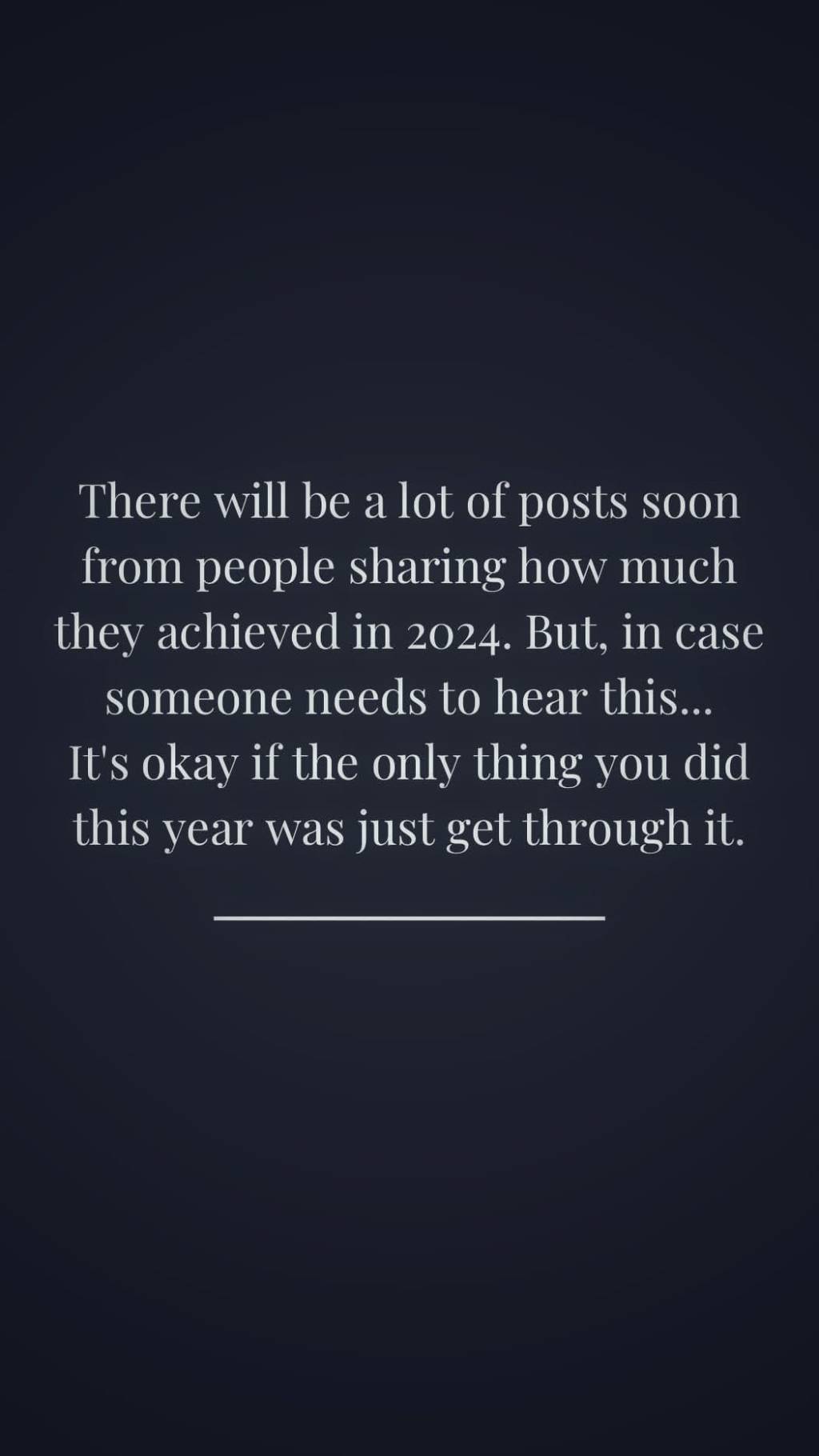
In the coming weeks, there will be many memes on social media glamourising the achievements of others in 2024.

Meme from Law Of Attraction
For those who need reminding, the success of others is not your failure. You are enough.
“Everyone’s “best” is different”
As I sat on the loo the other day and successfully lobbed the cardboard insert of the toilet roll straight into the bathroom bin, that advice came to mind. Decidedly, one of my greater achievements in a challenging year, I found myself celebrating the awesome throw with a feeble fistpump.
For some time now, we’ve been going through “a thing” at home, which escalated towards the end of they year, creating an ominous grey cloud above our home. It was one of those difficult periods that no family anticipates but must find the strength to navigate somehow, and though the clouds have momentarily lifted, the risk of new storms is never far away.
Life sucks at times and the lows and the challenges are as big a part of the experience as the glimmers are.
We are stoic Brits, and in the aftermath of our recent challenge, we tried to downplay the pain. But we also tried to appreciate what we learned from the situation. Because although it may require a magnifying glass to see them, positives usually emerge out of difficult situations as well.
Re-evaluation becomes a popular pastime in middle age
It may surprise the younger generations to know that those of us fortunate to find more time on our hands in our retirement – those of us who have already come to terms with the what-ifs and regrets – plan for what’s left of our future with the same zeal as them. There is also an extra extra benefit for us – the knowledge that the consequences of our actions won’t last a lifetime.
It is likely that our plans will look very different to those of our young adult years.
“Aging is an extraordinary process whereby you become the person you always should have been,” said David Bowie, who had clearly discovered this wisdom.
Look for the positives in challenging times
For some of us, how we define success may be part of that re-evalution. It has happened to me. At some point during the last few years, I had a light bulb moment and realised, finally, who I want to be in this next stage.
I realised when I looked back, that society had indoctinated me to seek its definition of success – where, ultimately, materialism is the greatest measure in the form of the big house, big career, perfect relationships and kids.
But what if we don’t achieve all those things? What if, when we reach the finale of our lives, we feel disappointment rather than pride, leading us to question our achievements and contribution?
Hopefully, experience, greater self-awareness and growth help navigate the confusion because everyone has worth and value in life’s rich tapestry, even if it’s not publicly recognised.
What was the point of it all?
Unfortunately, some of us don’t recognise this wisdom until too late. We grind away, finding the rent, paying off the mortgage, raising kids and caring for others with little real thanks. Especially women, who often hold everything together at the expense of their own happiness.
Social media is another pressure. Always there, pitting us against each other, shaming us and creating guilt. Its fascination with and celebration of what it categorises as high achievers – celebrities and Royals rather than nurses and teachers – compounds those feelings of inadequacy whether that’s in our careers, relationships, or parenting. For women, it even makes us question our physical appeal.
There’s always that voice. What did you achieve today? Did you really make the best use of your time?
Society’s way of measuring success is ableist
What you learn from those less fortunate like people with disabilities or other limitations – mental, physical or sociological – is that success, and I hate that word, (and not because I’m a loser!) should be determined by our personal best rather than society’s expectations.
In the education system, best practice is to “differentiate” the learning so that children with additional needs work at their own pace and level. However, there is little allowance for that in the adult world, which intensifies stigma and judgment.
In my work as a teacher’s aide, I struggled with the class rewards system, i.e. trophies handed out to the highest achievers. Although I understood the argument for building resilience, it never sat right with me that children with learning disorders or physical disabilities (who had also given their best) were ignored (or worse, patronised). From an early age, they were being taught they weren’t good enough – even though the playing field wasn’t level.
In the adult world, time and time again, the most powerful, the loudest voices, and the biggest rule-breakers get their way.
Is a carer any less “successful” than a lawyer?
Is the carer, who puts their life on hold to look after a loved one, any less “successful” than the lawyer who charges thousands of dollars per hour? Is the victim of war or famine – who has prioritised the survival of their family over their personal dreams – any less driven or worthy?
What is problematic about a meritocracy is that our future is often mapped out before we are born or during early childhood. It is one of those “uncertain” events I wrote about in my recent post that we have little control over. And yet, despite our understanding of the influence of adverse childhood experiences – ACEs – and their huge impact on development, mental health, happiness and achievement, we make little allowance for them when we measure success.
Should we expect the same outcomes from the child born without a limb, raised in poverty (with poor access to education or basic needs), or victims of intergenerational trauma or abuse?
“Survival of the fittest” may be the reality in the natural world but isn’t it an ableist cliche in a modern society that has, if it chose, the resources to improve everyone’s lives?
Adverse childhood experiences impact outcomes
Psychologists understand the many ways these adverse experiences in childhood can affect a person’s future. However, though those children are pawns in the game of life, most are left to suffer the consequences and stigma with little support.
Many don’t.
So, if the meme at the top of this post resonates with you and your biggest achievements this year were watching all six seasons of your favourite tv series, dragging yourself out of the house for a twenty-minute walk each day, showing up at work, or putting a decent meal on the table each evening, that’s okay. I’ve realised that you don’t have to prove anything to anyone.
My impressive toilet roll game aside, below is a list of the achievements and new practices I’m most proud of this year:
- Work – Despite the leap in my anxiety levels and the inevitable freeze-mode that often accompanies trauma, I turned up to work most of the time – usually robotically and wearily with one eye on the clock. But I did it. To be honest, it was a good distraction.
- Kindness and compassion – I made a conscious effort not to judge or jump to conclusions about people and their decisions and offered my help to anyone who needed it. Despite my social anxiety, I went directly to the coalface, volunteering at a food kitchen once a month. Not because I want a medal – although it is a good strategy for depression – but because our personal situation has given me a better understanding of the risks of poor mental health, true hardship and stigma.
- New learning – Maintaining curiosity is something I have prioritised in middle age. Emotional challenges exacerbate lethargy and brain fog in me, so I’ve tried to combat them with new learning. This year I’ve attended writers festivals and book clubs, kept abreast of the daily news, and recently committed to Duolingo and The New York Times “Spelling Bee”, so it doesn’t break the bank, either.
- Servicing friends – “Servicing” is a horrible way to describe my relationships with my besties, but sometimes that’s how it felt. I wasn’t the best company most of this year and I didn’t want to drag my friends down with me. There ware many days when all I really wanted to do was stay home in bed and eat cheese. However, most of the time I tried to stick to my commitments, even if it took a glass of wine to leave the house. I value my close friends and their support – even more so this year – and I needed them to know that.
- Self-care – Prioritising self-care smacks of privilege, I know. But if you’ve read “The body knows the score,” you’ll understand its importance. The truth is, self-care sought me this year. Recalibration came through swimming, walking in nature, coffees with friends or wandering aimlessly around the mall. My body sought calm so I indulged it when it demanded it. I also stop chasing people who don’t value me – a tough choice for someone with an irrepressible desire for validation – and I end this year more at peace with myself than I’ve ever been. I’m proud of the person I’ve become, even if my social circle has shrunk.
- Self-love – One of the problems with anxiety is that it breeds perfectionism and self-criticism. Hence, I’ve made a conscious decision to stop questioning what I’m doing wrong all the time and think more about what I do right. Poor self-esteem and hyper-sensitivity have lead to dangerous people-pleasing and self-sabotage traits that don’t serve this new version of me.
Each of us measures success differently
Time and experience generate our personal definition of success. And as I approach my sixtieth birthday, my markers for achievement have changed. These days, compassion, gratitude, and authenticity motivate me much more than the traditional markers.
I’m no saint or save-the-world crusader, but I have evolved and wear the “woke” hat proudly – sorry, Dad. I have also learned about self-compassion. Time, circumstances and self-reflection have changed my perception of how to live a meaningful life. As long as I have a roof over my head, my health, and family and friends close by, I am less interested in being seen or delusions of grandeur.
I have benefitted from privilege and I’d be lying if I said I didn’t enjoy those experiences at the time. But now, as I embrace the uncertainty of my longevity, the picture in my head of how I want to live this next stage is clearer. More mindful of intersectionality and the many layers and nuances of our existence, I aspire to judge, worry and buy less, to seek more calm and impose stronger boundaries. It’s simple really: I want to appreciate what I have.
 LOUISA SIMMONDS
Leave a comment